
Don’t Let AI Write Your Story
Artificial intelligence is changing our lives. Is it for better or worse? It depends. AI is a tool, and like every tool, it’s how we use it. A hammer can build a house or just put a massive hole in the wall, especially if you throw the hammer in frustration from four feet away. (or so I’m told)
Lately, I started wondering: What else might AI change? Not just our work: how we search for information, write emails, create images, or analyze data, but our lives. What about our stories? So, I dove into curiosity and had a conversation with Claude.
“Claude,” I asked, “if characters in fairy tales had AI, how might it change their stories?”
The answer was both funny and thought-provoking.
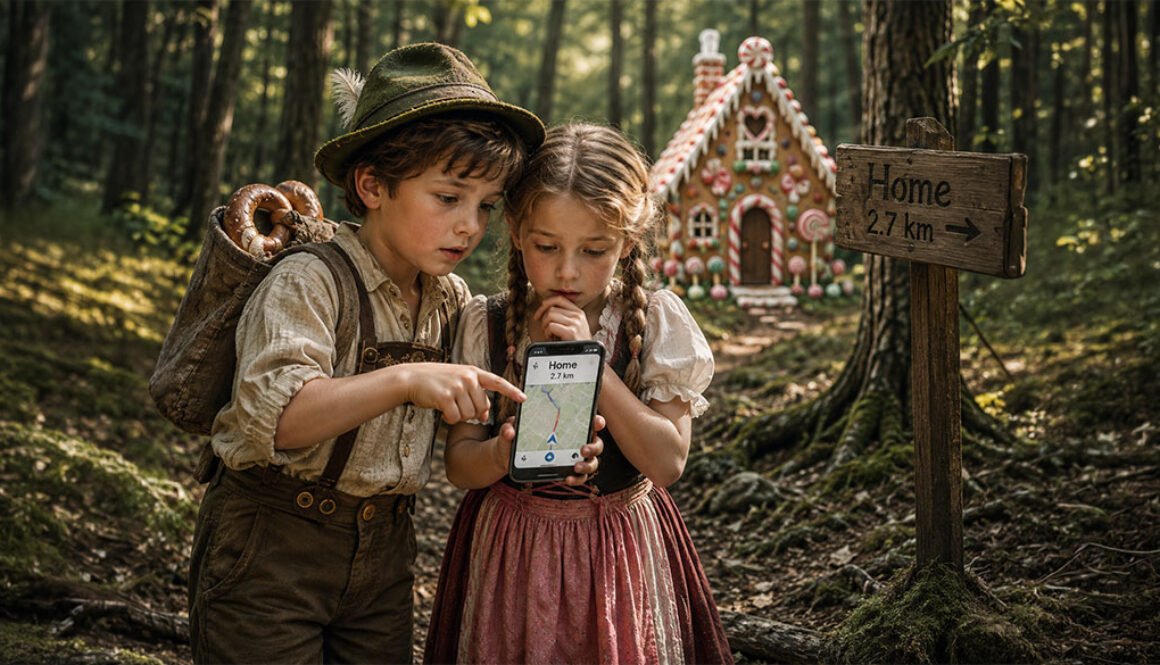
Hansel and Gretel: No More Breadcrumbs
Poor Hansel and Gretel wouldn’t have needed breadcrumbs. An AI assistant with GPS could have mapped their route home. Better yet, it could have sent an alert: “Warning: This forest contains a suspiciously high concentration of candy architecture.”
Problem solved.
Little Red Riding Hood: Voice Verification
Little Red Riding Hood’s biggest problem was trusting the wrong person. If she had AI, a voice-verification system could have immediately flagged that something was off: “Grandma” doesn’t sound like Grandma. The wolf would have been unmasked before Red ever walked through the bedroom door.
Problem solved.
Cinderella: Facial Recognition to the Rescue
Cinderella could have skipped the entire glass slipper mystery. Instead of the prince traveling around the kingdom, looking for the mysterious woman whose foot fit a shoe, facial recognition could have identified her immediately. No midnight deadline. No frantic carriage ride. No lost slipper or shoe-fitting tour. Efficient? Absolutely. Romantic? Not so much.
Problem solved.
And Then There Was the Magic Mirror
Claude pointed out something I hadn’t considered. The Queen’s magic mirror was basically an early version of an AI assistant. She asked the mirror questions. It knew things she didn’t know and gave her answers. The problem? There were no ethical guardrails. If there had been, the mirror wouldn’t have told her where to find Snow White hiding in the forest. Imagine the employee handbook. “Magic Mirror Usage Policy: Do not provide information that could facilitate the murder of your stepdaughter.” Seems reasonable.
Problem solved. (with serious moral implications)
But Then Claude Said Something Interesting
After giving me all these examples, Claude pointed out that while AI would have been helpful, it also would have made the stories shorter and more boring. Huh, I hadn’t considered that.
We tend to think efficiency is automatically good. Why waste time getting lost when GPS can tell us exactly where to go? Why struggle through a difficult problem when AI can give us the answer? Why spend hours figuring something out when a tool can do it in seconds? And sometimes, that’s exactly what we should do. AI can save time. It can help us solve problems. It can surface information, identify patterns, generate possibilities, and make certain tasks dramatically easier. That’s useful. But we need to be careful.
The Problem Isn’t AI. It’s What We Give Away to It.
The more capable these tools become, the easier it is to hand over things that we don’t want to lose. Our–
- curiosity
- judgment
- creativity
- experimentation
- willingness to be uncomfortable
- stories
There’s value in figuring some things out for ourselves. What–
- new path or experience might we find when we get lost?
- do we learn from our mistakes or when a conversation doesn’t go according to plan?
- shows up when we sit with and explore a question long enough to discover what we really think?
We don’t become better thinkers by having the answers handed to us. We become better thinkers by thinking, experimenting, struggling, and figuring things out for ourselves.
How this Impacts Leadership
As leaders, we’re going to be navigating AI in increasingly practical ways: How can we use AI to improve productivity, automate repetitive work, and make sure AI isn’t hallucinating or leading us down the wrong path just for fun? These are important questions. But here’s a critical point we must not lose sight of:
Leaders are Humans Leading Humans.
Leadership isn’t simply the ability to process information. It’s–
- judgment
- context
- knowing when the technically correct answer isn’t the right answer
- reading the room
- understanding what isn’t being said but needs to be heard
- having the courage to make decisions when there isn’t enough information to guarantee you’re right
- building trust
- dealing with people who, inconveniently, are not algorithms
Leadership is all the human stuff.
Don’t Let AI Write Your Story
AI can help us write, brainstorm, learn, and analyze. It can even help us imagine what might have happened if Hansel and Gretel had GPS. But it can’t live our lives for us. It can’t lead our people. And we don’t want it to.
The parts of our lives that make the best stories are rarely the parts that went perfectly according to plan. They’re the wrong turns, stepping into the unknown, making mistakes, and being surprised by the possibilities. They’re the moments when we had no idea what we were doing and figured it out anyway. That’s when we learn, grow, and discover things about ourselves we couldn’t have found by following the most efficient route from Point A to Point B. Transformation isn’t a linear path. Neither is life.
So yes, use AI. Use it well and thoughtfully. Let it make your life easier and take the tedious stuff off your plate, so you have more time for the things that really matter. But don’t outsource the parts of yourself that make your life yours. If AI solves every problem as soon as we encounter it, we may be more efficient. But we’ll end up with boring stories and lives that are far less interesting to live.
I don’t want AI to write my story for me. I want to write every chapter, explore what unfolds, and feel the excitement of not knowing what may happen next.
===================================
Rachel Burr is an executive and leadership coach with over 20 years of experience working with CEOs and the C-suite across all industries, in organizations of from 200 to 10,000 employees. Rachel holds dual master’s degrees in Organization Development and Clinical Psychology, and numerous certifications in the field of executive coaching. Rachel is a “people expert” who works with clients to unleash their leadership potential.